


Page 10 - Steel Metallurgy eMagazine Volume September 2026
P. 10
FACE TO FACE


               “


               The process eliminates
               gas-fired billet reheating,
               removing a major source
               of fossil-fuel-related CO₂
               emissions                 “


               — Bernhard Steenken
                   CSO, Region APAC & MEA
                   SMS group


            objectives. Its process-efficient design,
            reduced energy requirements and
            compact plant layout decrease capital
            and operating expenditure across
            costs  associated  with  land  size,    site
            infrastructure  and  buildings.  By
            integrating the entire production route,
            from scrap processing to finished rebar,
            the mill also minimizes material losses
            and keeps valuable resources within the
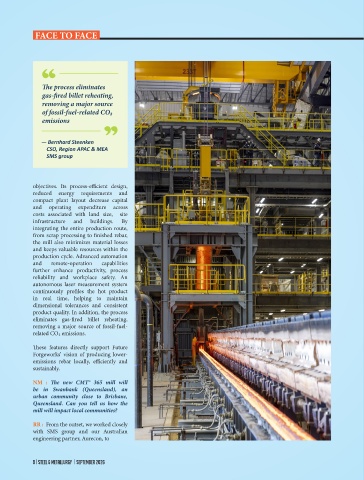
            production cycle. Advanced automation
            and    remote-operation  capabilities
            further enhance productivity, process
            reliability and workplace safety. An
            autonomous laser measurement system
            continuously profiles the hot product
            in real time, helping to maintain
            dimensional tolerances and consistent
            product quality. In addition, the process
            eliminates gas-fired billet reheating,
            removing a major source of fossil-fuel-
            related CO₂ emissions.

            These features directly support Future
            Forgeworks’ vision of producing lower-
            emissions rebar locally, efficiently and
            sustainably.

            NM :  The new CMT® 365 mill will
            be in Swanbank (Queensland), an
            urban community close to Brisbane,
            Queensland. Can you tell us how the
            mill will impact local communities?

            RR :  From the outset, we worked closely
            with SMS group and our Australian
            engineering partner, Aurecon, to


            8 STEEL & METALLURGY    SEPTEMBER 2026

