


Page 20 - Steel Metallurgy eMagazine Volume September 2026
P. 20
STEEL MILL MAINTENANCE
             REFRACTORY


            systems can accelerate wear or lead to  strip tracking issues. Instability within   SELECTING THE
            catastrophic failures that halt operations  gearboxes and back-up bearings can
            altogether.                        also affect speed consistency and gauge  ‘RIGHT’ LUBRICANT
                                               control, leading to thickness variation
                 IMPACT ON EQUIPMENT           and reduced dimensional accuracy. For   Although an important starting point,
                     PERFORMANCE               this reason, lubrication should be viewed   Original  Equipment  Manufacturer
                                               not only as a maintenance activity, but as   (OEM) specifications do not always
            Lubrication also plays a critical role  a key contributor to uptime, operational  reflect actual operating conditions,
            in   equipment  performance.  Poor  efficiency, and product quality.  including temperature, load, speed, and
            lubrication  increases  friction  and
            resistance, generating heat and reducing
            mechanical efficiency. In gear systems,
            this can result in inconsistent torque
            transmission, forcing operators to reduce
            speed or increase power consumption
            to maintain output. Over time, wear-
            induced clearances further reduce
            efficiency and place additional stress on
            equipment. While these losses may not
            immediately stop production, they can
            significantly impact throughput and
            energy costs.


             IMPACT ON PRODUCT QUALITY

            Product quality is equally influenced
            by lubrication condition. Insufficient
            lubrication in bearings and rollers can
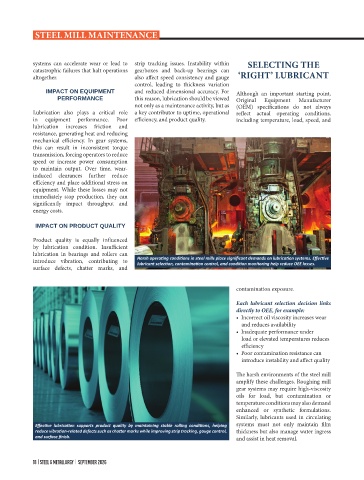
            introduce vibration, contributing to   Harsh operating conditions in steel mills place significant demands on lubrication systems. Effective
                                                lubricant selection, contamination control, and condition monitoring help reduce OEE losses.
            surface defects,  chatter  marks,  and


                                                                                  contamination exposure.

                                                                                  Each lubricant selection decision links
                                                                                  directly to OEE, for example:
                                                                                  •  Incorrect oil viscosity increases wear
                                                                                      and reduces availability
                                                                                  •  Inadequate performance under
                                                                                      load or elevated temperatures reduces
                                                                                      efficiency
                                                                                  •  Poor contamination resistance can
                                                                                      introduce instability and affect quality

                                                                                  The harsh environments of the steel mill
                                                                                  amplify these challenges. Roughing mill
                                                                                  gear systems may require high-viscosity
                                                                                  oils for load, but contamination or
                                                                                  temperature conditions may also demand
                                                                                  enhanced or synthetic formulations.
                                                                                  Similarly, lubricants used in circulating
             Effective  lubrication  supports  product  quality  by  maintaining  stable  rolling  conditions,  helping   systems must not only maintain film
             reduce vibration-related defects such as chatter marks while improving strip tracking, gauge control,   thickness but also manage water ingress
             and surface finish.                                                  and assist in heat removal.


            18 STEEL & METALLURGY    SEPTEMBER 2026

