


Page 28 - Steel Metallurgy eMagazine Volume September 2026
P. 28
DEMAND FORECASTING


            its long-term objectives. The assessment   THE PROGRESS SO            steel  sector  in  recent  times.  Several
            is based on publicly available information                            indicators improved  simultaneously—
            from the Ministry of Steel, World Steel  FAR: ENCOURAGING             capacity utilisation remained healthy,
            Association and other industry sources,   TRENDS, BUT THE             domestic  demand    continued  to
            together with observations drawn from   JOURNEY IS FAR                expand, exports recovered and market
            my professional experience.                                           sentiment strengthened. Such broad-
                                                  FROM COMPLETE                   based improvement is generally a better
            One aspect has become increasingly                                    indicator of sectoral health than growth
            evident over the years. Formulating a                                 in any single parameter.
            national policy is only the beginning of   Nearly a decade after the National Steel
            the journey. Translating policy targets   Policy was introduced, it is evident that   TWO DEVELOPMENTS DURING
            into operating capacity requires sustained   India has made substantial progress   THE PAST YEAR DESERVE
            investment, timely statutory clearances,   towards its long-term objectives. The   PARTICULAR ATTENTION.
            efficient logistics, reliable raw material   expansion of steelmaking capacity,
            supply and favourable market conditions   sustained  growth  in  domestic  The first relates to trade policy. The
            over an extended period. Delays in any   consumption  and  record  levels  of   introduction of the 12% provisional
            one of these areas can influence the pace   production demonstrate that the policy   safeguard duty on flat steel imports
            at which capacity is ultimately created.  has provided a clear direction for the   significantly altered the domestic market.
                                               industry. While the 2030-31 targets   During FY2025-26, finished steel exports
            The last decade has also demonstrated   have not yet been achieved, the overall   increased by nearly 36%, while imports
            that external developments can alter the   trajectory remains positive.  declined by about 32%, enabling India
            trajectory of the industry in ways that are                           to regain its position as a net exporter of
            difficult to anticipate. The COVID-19   India's crude steelmaking capacity   finished steel.
            pandemic,  disruptions  in  global  supply   has increased from about 109 MT in
            chains, changes in international trade   FY2014-15 to 220.3 MT in FY2025-  The speed with which trade flows
            patterns, geopolitical developments and   26, effectively doubling over the past   responded demonstrates the influence
            increasing emphasis on decarbonisation   decade. During the same period, crude   that calibrated trade measures can have
            have  all  influenced the  operating   steel production reached 168.4 MT,   on domestic industry, particularly during
            environment for the steel sector. At   representing a year-on-year growth of   periods of global oversupply.
            the same time, India has continued to   10.7%,  while  finished  steel  production
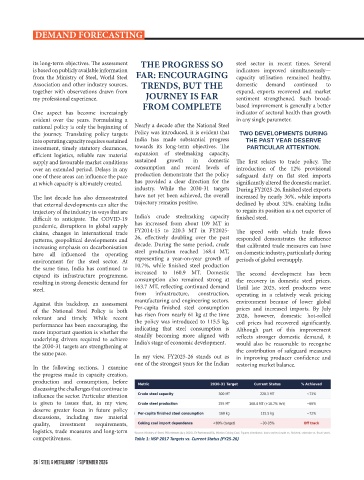
            expand its infrastructure programme,   increased to 160.9 MT. Domestic   The second development has been
            resulting in strong domestic demand for   consumption also remained strong at   the recovery in domestic steel prices.
            steel.                             163.7 MT, reflecting continued demand   Until late 2025, steel producers were
                                               from   infrastructure,  construction,  operating in a relatively weak pricing
                                               manufacturing and engineering sectors.   environment  because  of  lower  global
            Against this backdrop, an assessment
            of the National Steel Policy is both   Per-capita finished steel consumption   prices and increased imports. By July
                                               has risen from nearly 61 kg at the time
            relevant and timely. While recent   the policy was introduced to 115.5 kg,   2026, however, domestic hot-rolled
            performance has been encouraging, the   indicating  that  steel  consumption is   coil prices had recovered significantly.
            more important question is whether the   steadily becoming more aligned with   Although part of this improvement
            underlying drivers required to achieve   India's stage of economic development.  reflects stronger domestic demand, it
            the 2030-31 targets are strengthening at                              would also be reasonable to recognise
            the same pace.                                                        the contribution of safeguard measures
                                               In my view, FY2025-26 stands out as   in improving producer confidence and
                                               one of the strongest years for the Indian   restoring market balance.
            In the following sections, I examine
            the progress made in capacity creation,
            production and consumption, before
            discussing the challenges that continue to
            influence the sector. Particular attention
            is given to issues that, in my view,
            deserve greater focus in future policy
            discussions, including raw material
            quality,  investment  requirements,
            logistics, trade measures and long-term
            competitiveness.                   Table 1: NSP 2017 Targets vs. Current Status (FY25-26)


            26 STEEL & METALLURGY    SEPTEMBER 2026

