


Page 30 - Steel Metallurgy eMagazine Volume September 2026
P. 30
DEMAND FORECASTING


            Having worked on both policy and  will require maintaining this momentum  Industry  estimates  indicate  that
            project implementation, one lesson  over several more years while addressing  bridging this capacity gap could require
            I have observed repeatedly is that  structural issues that continue to  investments of nearly  ₹10 lakh crore
            investment decisions in the steel  influence the sector's competitiveness.  (approximately US\$120 billion) over the
            sector are highly sensitive to market  Those issues become more apparent  coming years. Such investments depend
            conditions. Large integrated steel plants  when the current progress is compared  not only on long-term confidence
            require substantial capital investment  against the scale of the remaining targets.  in domestic demand but also on the
            and have long gestation periods. Stable                               predictability of policy, access to finance
            prices and greater visibility on future   THE REMAINING               and reasonable expectations regarding
            demand encourage investment, whereas                                  future profitability. Large steel projects
            prolonged  periods of price  uncertainty   CHALLENGE:                 typically  have  long  gestation periods,
            often result in delays or deferment        CAPACITY                   and  investment  decisions taken  today
            of expansion plans. In that context,   EXPANSION ALONE                are based on market expectations
            the recent improvement in market                                      several years into the future rather than
            conditions  is  encouraging because  it   WILL NOT BE                 prevailing market conditions alone.
            creates a more favourable environment       ENOUGH
            for future capacity addition.                                         During my tenure in the Ministry of Steel,
                                                                                  I had the opportunity to monitor the
            At the same time, the current      The progress achieved over the past   progress of several major steel projects
            momentum should be viewed with     decade is significant and deserves   across both the public and private
            appropriate caution. The safeguard   recognition. However, when viewed   sectors. One observation has remained
            duty is a temporary measure with a   against the objectives of the National   consistent over the years: announcing
            phased reduction over the coming   Steel Policy, it is equally clear that the   capacity  expansion  is  relatively
            years. Sustained growth cannot depend   next phase of growth will be more   straightforward,  but commissioning
            indefinitely  on  trade  protection.  Over   demanding than the last.  projects within the planned timelines
            the longer term, the competitiveness of                               is  considerably  more  challenging.  Land
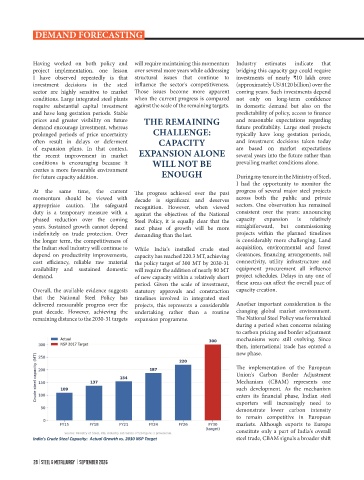
            the Indian steel industry will continue to   While  India's  installed  crude  steel   acquisition, environmental and forest
            depend on productivity improvements,  capacity has reached 220.3 MT, achieving   clearances, financing arrangements, rail
            cost efficiency, reliable raw material  the policy target of 300 MT by 2030-31   connectivity, utility infrastructure and
            availability and sustained domestic  will require the addition of nearly 80 MT   equipment procurement all influence
            demand.                            of new capacity within a relatively short   project schedules. Delays in any one of
                                               period. Given the scale of investment,   these areas can affect the overall pace of
            Overall, the available evidence suggests  statutory approvals and construction   capacity creation.
            that the National Steel Policy has  timelines involved in integrated steel
            delivered measurable progress over the  projects, this represents a considerable   Another important consideration is the
            past decade. However, achieving the  undertaking rather than a routine   changing global market environment.
            remaining distance to the 2030-31 targets  expansion programme.       The National Steel Policy was formulated
                                                                                  during a period when concerns relating
                                                                                  to carbon pricing and border adjustment
                                                                                  mechanisms were still evolving. Since
                                                                                  then, international trade has entered a
                                                                                  new phase.

                                                                                  The implementation of the European
                                                                                  Union's Carbon Border Adjustment
                                                                                  Mechanism (CBAM) represents one
                                                                                  such development. As the mechanism
                                                                                  enters its financial phase, Indian steel
                                                                                  exporters will  increasingly  need  to
                                                                                  demonstrate lower carbon intensity
                                                                                  to remain competitive in European
                                                                                  markets. Although exports to Europe
                                                                                  constitute only  a  part  of  India's  overall
            India's Crude Steel Capacity:  Actual Growth vs. 2030 NSP Target      steel trade, CBAM signals a broader shift


            28 STEEL & METALLURGY    SEPTEMBER 2026

