


Page 36 - Steel Metallurgy eMagazine Volume September 2026
P. 36
DEMAND FORECASTING


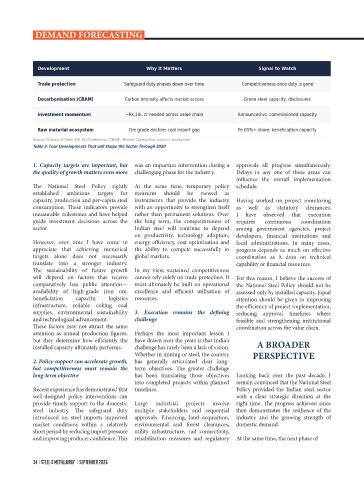
            Table 3: Four Developments That will Shape the Sector Through 2030


            1. Capacity targets are important,  but  was an important intervention during a  approvals all progress simultaneously.
            the quality of growth matters even more  challenging phase for the industry.  Delays  in any one  of these areas can
                                                                                  influence the overall implementation
            The National Steel Policy rightly  At the same time, temporary policy  schedule.
            established  ambitious  targets  for  measures  should  be  viewed  as
            capacity, production and per-capita steel  instruments  that  provide the  industry  Having  worked  on  project  monitoring
            consumption. These indicators provide  with an opportunity to strengthen itself  as  well  as  statutory  clearances,
            measurable milestones and have helped  rather than permanent solutions. Over  I  have  observed  that  execution
            guide  investment  decisions  across  the  the long term, the competitiveness of  requires  continuous  coordination
            sector.                            Indian steel will continue to depend  among government agencies, project
                                               on productivity, technology adoption,  developers, financial institutions and
            However, over time I have come to  energy efficiency, cost optimisation and  local  administrations.  In  many  cases,
            appreciate that achieving numerical  the ability to compete successfully in  progress depends as much on effective
            targets  alone  does not  necessarily  global markets.                coordination as it does on technical
            translate into a stronger industry.                                   capability or financial resources.
            The sustainability of future growth  In  my  view,  sustained  competitiveness
            will depend on factors that receive  cannot rely solely on trade protection. It  For this reason, I believe the success of
            comparatively less public attention—  must ultimately be built on operational  the National Steel Policy should not be
            availability of high-grade iron ore,  excellence and efficient utilisation of  assessed only by installed capacity. Equal
            beneficiation  capacity,  logistics  resources.                       attention should be given to improving
            infrastructure, reliable coking coal                                  the efficiency of project implementation,
            supplies, environmental sustainability  3. Execution remains the defining   reducing approval timelines where
            and technological advancement.     challenge                          feasible and strengthening institutional
            These factors may not attract the same                                coordination across the value chain.
            attention as annual production figures,  Perhaps the most important lesson I
            but they determine how efficiently the  have drawn over the years is that India's   A BROADER
            installed capacity ultimately performs.  challenge has rarely been a lack of vision.
                                               Whether in mining or steel, the country   PERSPECTIVE
            2. Policy support can accelerate growth,  has generally articulated clear long-
            but competitiveness must remain the  term objectives. The greater challenge
            long-term objective                has been translating those objectives  Looking back over the past decade, I
                                               into completed projects within planned  remain convinced that the National Steel
            Recent experience has demonstrated that  timelines.                   Policy provided the Indian steel sector
            well-designed policy interventions can                                with a clear strategic direction at the
            provide timely support to the domestic  Large  industrial  projects  involve  right time. The progress achieved since
            steel industry. The safeguard duty  multiple stakeholders and sequential  then demonstrates the resilience of the
            introduced on  steel  imports  improved  approvals. Financing, land acquisition,  industry and the  growing strength of
            market conditions within a relatively  environmental and forest clearances,  domestic demand.
            short period by reducing import pressure  utility infrastructure, rail connectivity,
            and improving producer confidence. This  rehabilitation measures and regulatory  At the same time, the next phase of


            34 STEEL & METALLURGY    SEPTEMBER 2026

