


Page 46 - Steel Metallurgy eMagazine Volume September 2026
P. 46
LUBRICATION
Has Your Lubrication System Kept Pace With Your Plant ?
H as Y o ur L u b ri c a t i o n S y s t e m K e p t P ac e W i th Y o ur P l a n t ?
Has Your Lubrication System Kept Pace With Your Plant ?
Your production has increased. Loads have changed. Machines are running harder. But is your lubrication system still
Your production has increased. Loads have changed. Machines are running harder. But is your lubrication system still
Your production has increased. Loads have changed. Machines are running harder. But is your lubrication system still
operating on yesterday’s design?
operating on yesterday’s design?
operating on yesterday’s design?
y o
l
e
es t
era
p
t
P
TEEL
S
L
r
ra
ANT
o
s co
mmi
en i
t wa
s
e
d
sio
n
y exac
t
d
a
l
t did w
h
y a
s i
A STEEL PLANT rarely operates today exactly as it did when it was commissioned. .
A
A STEEL PLANT rarely operates today exactly as it did when it was commissioned.
Over the years, production targets increase, machines run for longer hours, loads change, new
O v er t h e y e a r s, p r o d uc t io n t a r g ets in cr e a s e , m ac hin es r un f o r lo n g er h o ur s, lo ad s c h a n g e , n e w
Over the years, production targets increase, machines run for longer hours, loads change, new
p
d o
g co
l
in
era
t
in
ts a
n p
o
r
d a
n
e
adde
o
r
m
e m
e dem
din
g
a
n
di
t
n
lubrication points are added and operating conditions become more demanding. .
io
e
co
n
s b
r
ic
u
a
io
b
t
lubrication points are added and operating conditions become more demanding.
q
t
uir
e
g r
es
n
m
r
en
ts.
o
h
io
em
e c
t
es, a
g
h
a
n
in
pg
i
r
v
a
rade dr
e u
u
n
t
l
d p
et t
o m
s co
o
e
We upgrade drives, automation and process controls to meet these changing requirements.
We upgrade drives, automation and process controls to meet these changing requirements.
W
o
s t
ces
n a
t h
u
But how often do we ask:
s
e a
B
k:
o
w o
ft
But how often do we ask:
en do w
od
m a
n
g c
pe
y
n s
y
a
’
ti
s o
a
r t
s
r
e
t
l
r
ed f
e
s?
i
i
o bee
Has the lubrication system also been reviewed for today’s operating conditions?
e
w
s
u
b
c
n r
d
i
o
o
o
n
ti
v
o
n
a
ti
H a s t h e l Has the lubrication system also been reviewed for today’s operating conditions?
A pump running at every programmed interval does not necessarily mean every bearing is
A pump running at every programmed interval does not necessarily mean every bearing is
A p um p r unnin g a t e v er y p r og ra mm e d in t er va l do es n o t n e ces s a r i l y m e a n e v er y b e a r in g i s
receiving the lubrication it requires.
n i
es.
v
r receiving the lubrication it requires.
t r
e
in
uir
q
r
cei
a
ic
b
e l
h
u
g t
t
e
io
Nimit Mittal -
t Mi
N
imi
Nimit Mittal -
t
l -
ta
Managing Partner at
Sometimes, The lubrication system hasn’t failed—the plant has simply outgrown it.
e
n
n
r a
m has
a
g P
n
a
r
tn
a
i
g
l
a
p
e
ly o
a
t has s
n
i
im
l
u
t
n i
M
d—the p
’
w
g
t
r
t f
o
Sometimes, The lubrication system hasn’t failed—the plant has simply outgrown it. . Managing Partner at t
a
s
ri
c
o
n s
i
y
t
The l
e
u
t
b
o
es,
et
S
im
m
Cenlub Systems
y
S
s
e
t
C
Cenlub Systems s
e
ub
nl
m
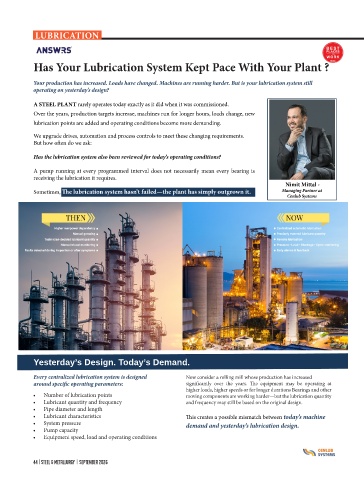
Yesterday’s Design. Today’s Demand.
Y esterday’ s Design. T oday’ s Demand. Now consider a rolling mill whose production has increased
Yesterday’s Design. Today’s Demand.
Every centralized lubrication system is designed
around specific operating parameters: significantly over the years. The equipment may be operating at
Every centralized lubrication system is designed
Every centralized lubrication system is designed N o w co n sider a r o l lin g mi l l w h os e p r o d uc t io n h a s in cr e a s e d
Now consider a rolling mill whose production has increased
higher loads, higher speeds or for longer durations Bearings and other
Number of lubrication points
•
around specific operating parameters: significantly over the years. The equipment may be operating at
moving components are working harder—but the lubrication quantity
around specific operating parameters:
e o
t
er t
t
n
a
y b
t
a
h
nific
e y
sig
e e
g a
in
p
e
a
r
y o
en
era
p
m
v
ui
t m
s. Th
l
q
• Lubricant quantity and frequency hig h er lo ad s, hig h er s p e e d s o r f o r lo n g er d ura t io n s B e a r in gs a n d o t h er
and frequency may still be based on the original design.
higher loads, higher speeds or for longer durations Bearings and other
in
b
u
N
o
f l
a
• • Number of lubrication points m o v in g co m p o n en ts a r e w o r k in g h a r der —b u t t h e l u b r ic a t io n q u a n t i t y
n p
t
ic
um
b
r
er o
io
ts
•
Pipe diameter and length
moving components are working harder—but the lubrication quantity
t q
a
Lubricant characteristics
• • Lubricant quantity and frequency a and frequency may still be based on the original design.
u
a
ic
L
y a
u
i
t
b
c
r
q
d f
uen
n
n
t
n
y
e
r
•
This creates a possible mismatch between today’s machine
y s
d o
e o
h
e b
n t
a
i
l
s
t
e
l b
a
q
e
l desig
uen
n
n.
r
d f
a
c
ig
y m
r
in
System pressure
•
P
i
d len
n
gt
a
h
p
m
et
• • Pipe diameter and length demand and yesterday’s lubrication design.
e di
er a
mac
r
h
d
t
o
a
’
s
y
ine
t
er
h
rac
t c
a
s
i
Lubricant characteristics
• • L u b • ic a n Pump capacity t ics This creates a possible mismatch between today’s machine
h b
e
a
et
w
en
e
t
es a p
Thi
si
a
le mi
sm
b
os
c
s cr
t
System pressure
• • S ys t • Equipment speed, load and operating conditions demand and yesterday’s lubrication design. .
ur
em p
s
e
es
r
b
m
t
u
i
r
g
a
n
y
’
da
r
l
de
s
e
yes
io
a
d
d
n
des
n
a
n
ic
t
aci
Pum
• • Pump capacity y
p c
a
p
t
ad a
io
E
t
p
in
q
era
t
n
di
n
g co
d o
• • Equipment speed, load and operating conditions s
t s
e
m
p
p
en
e
d
, lo
n
ui
1 STEEL & METALLURGY September 2026
44 STEEL & METALLURGY SEPTEMBER 2026
1
1 STEEL & METALLURGY September 2026STEEL & METALLURGY September 2026

